
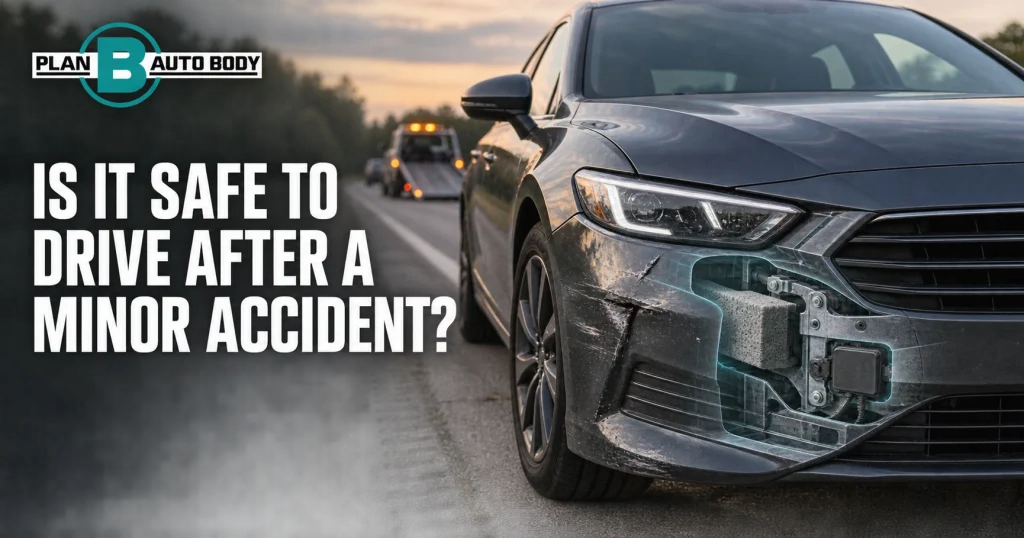
Sometimes -but only when no one is injured, the damage appears cosmetic, and the vehicle steers, brakes, and operates normally.
Do not drive if you notice leaking fluids, tire or wheel damage, steering or brake problems, deployed airbags, warning lights, smoke, broken lights, unusual noises, or loose parts. A vehicle that starts is not automatically safe. If you cannot confidently assess its condition, arrange a tow.
Key Takeaways
- A running vehicle is not necessarily safe to drive.
- Tow it if steering, braking, tires, airbags, lights, or fluid systems may be damaged.
- Minor-looking damage can hide structural, suspension, or sensor problems.
- No dashboard warning light does not prove that ADAS sensors are correctly aligned.
- When uncertain, tow the vehicle and arrange a professional inspection.
What Counts as a Minor Accident?
A minor accident usually means a low-speed rear-end collision, parking-lot bump, bumper tap, sideswipe, or curb strike with limited visible damage.
However, “minor” describes how the accident appears. It does not confirm what happened behind the bumper, under the vehicle, or near the wheels and safety sensors.
Can I Drive After a Fender Bender?
You may be able to drive a short distance after a fender bender if there are no injuries, leaks, warning lights, damaged tires, loose parts, unusual sounds, or changes in steering and braking.
Use the vehicle’s condition not the apparent size of the accident to decide.
| Vehicle Condition | Recommended Action |
|---|---|
| Small scratch or dent with normal steering, braking, lights, and tires | A short drive for an inspection may be reasonable |
| Bumper damage, panel gaps, or damage near a wheel or sensor | Arrange an inspection as soon as possible |
| Fluid leak, tire damage, control problem, smoke, or deployed airbag | Do not drive; arrange a tow |
| You are uncertain about the vehicle’s condition | Choose towing instead of guessing |
An online checklist cannot confirm that a specific vehicle is roadworthy. It can only help identify reasons not to drive.
When Should You Tow a Car After an Accident?
Tow the vehicle whenever collision damage could affect control, visibility, cooling, structure, or occupant-protection systems.
Do not continue driving if you notice:
- Fluid leaking underneath the vehicle
- Smoke, sparks, or a fuel, burning, or chemical odor
- A damaged, flat, rubbing, or unusually angled tire
- A bent or visibly damaged wheel
- Steering that feels loose, heavy, crooked, or pulls
- Brakes that feel soft or respond differently
- Parts hanging, dragging, or touching a tire
- A hood, door, trunk, or liftgate that will not latch
- Broken headlights, brake lights, or turn signals
- New airbag, brake, ABS, temperature, or stability warnings
- Grinding, scraping, clunking, or strong vibration
- Damage blocking the driver’s view
The National Highway Traffic Safety Administration advises that deployed airbags must be replaced before the vehicle is driven again.
What If There Is No Visible Damage After an Accident?
No visible damage after an accident does not prove that the vehicle is undamaged. Flexible bumper covers and exterior panels may hide damage to components underneath.
Where the vehicle was hit can indicate what should be checked:
| Impact Area | Possible Hidden Damage |
|---|---|
| Front or rear bumper | Mounting tabs, energy absorbers, reinforcement bars, wiring, radar, or parking sensors |
| Wheel or curb impact | Tire, wheel, alignment, steering, suspension, wheel bearing, or underbody |
| Grille or front corner | Cooling components, lights, hood latch, radar, brackets, or surrounding structure |
| Door or side panel | Door latch, hinges, window operation, side-impact sensors, pillar, or panel alignment |
These are inspection areas, not a diagnosis. The exact damage depends on the vehicle, impact direction, speed, and point of contact.
Can ADAS Sensors Be Damaged Without a Warning Light?
Yes. A camera, radar unit, sensor, or mounting bracket can move out of position without immediately producing a dashboard warning.
Advanced Driver Assistance Systems may control:
- Automatic emergency braking
- Lane-departure warnings
- Lane-keeping assistance
- Adaptive cruise control
- Parking assistance
- Blind-spot monitoring
These systems depend on precise sensor positioning. I-CAR explains that calibration may be required after bumper, windshield, suspension, or structural work.
Plan B Autobody provides ADAS recalibration after a collision according to the repair requirements for the specific vehicle.
What Should You Check Before Moving the Vehicle?
Complete this safety check before attempting to move the vehicle:
- Check for injuries. Call 911 if anyone may be injured or the crash creates an immediate danger.
- Look underneath the vehicle. Check for fresh fluid, smoke, sparks, or broken components.
- Inspect every wheel and tire. Look for cuts, bulges, flat tires, bent wheels, or unusual angles.
- Check exterior parts. Make sure nothing is touching a tire, dragging, or likely to come loose.
- Test the lights. Check the headlights, brake lights, turn signals, and hazard lights.
- Watch the dashboard. Look for warnings that were not present before the accident.
- Test controls carefully. Stop if the steering or brakes feel different.
- Document the scene. Photograph the vehicles, damage, license plates, road conditions, and debris when safe.
For crashes on Tennessee interstates or controlled-access highways, TDOT advises moving a damaged vehicle away from active traffic when no one appears seriously injured and the vehicle can be moved normally and safely.
Moving a vehicle a short distance to the shoulder is different from driving it home. Once outside the traffic lane, reassess the damage before going farther.
When the vehicle fails any check above, arrange a tow instead of risking the drive. Drivers involved in a crash outside Middle Tennessee need a recovery service local to the scene before repairs get arranged at home. In the Chicago area, Blackhawks Towing dispatches accident recovery and flatbed towing around the clock.
Why Does a Professional Collision Inspection Matter?
A visual check or photo estimate can document obvious damage, but it may not reveal problems behind a bumper, panel, wheel, or interior trim.
Depending on the impact, an inspection may include:
- Bumper and body-panel alignment
- Wheels, suspension, and steering
- Frame or unibody measurements
- Damage behind exterior panels
- Diagnostic scans and ADAS requirements
- Manufacturer repair procedures
- Insurance documentation and supplements
A photo estimate can help start the process. An in-person inspection is more reliable when hidden or structural damage may be present. Drivers can request a free repair estimate from Plan B Autobody.
Where Can Nashville Drivers Get Their Vehicle Inspected?
Plan B Autobody is an independent, I-CAR Gold Class collision center located in Goodlettsville and serving Nashville and Middle Tennessee.
The repair process is built around the vehicle owner not an insurance company’s cost target. The team documents hidden damage, coordinates with insurers, follows manufacturer repair procedures, uses OEM parts as the standard, and checks whether cameras or sensors require recalibration.
If your vehicle has been involved in a low-speed collision, schedule a collision damage inspection and auto body repair in Nashville.
If the vehicle is not safe to drive, arrange for it to be towed to:
Plan B Autobody
1621 US-31W
Goodlettsville, TN 37072
Phone: (615) 672-7022
What Else Should Drivers Know After a Minor Accident?
Can I drive with a damaged bumper?
A surface scratch may not affect drivability, but a loose bumper, damaged lights, dragging parts, tire contact, broken mounts, or hidden reinforcement damage requires inspection. If the bumper is unstable or you cannot see what was damaged underneath, do not continue driving.
How soon should I have the vehicle inspected?
Arrange an inspection as soon as reasonably possible. Early inspection can identify hidden damage, prevent loose or misaligned parts from worsening, and document which problems resulted from the accident.
Will insurance pay for towing after an accident?
Towing coverage depends on the policy and accident circumstances. Contact the insurer to confirm coverage, but do not continue driving an unsafe vehicle while waiting for authorization.
Should I take the vehicle to a body shop or a mechanic?
Choose a collision repair center when the accident affected body panels, bumpers, structure, paint, glass, wheels, or safety sensors. Mechanical symptoms involving the engine or drivetrain may require additional diagnosis. A collision inspection can help determine which repairs and specialists are needed.