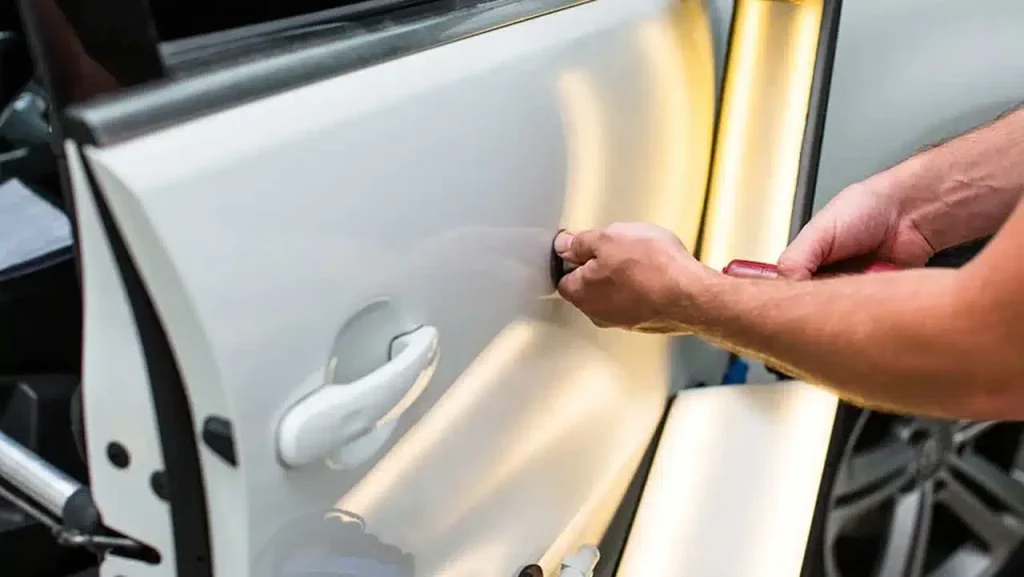


Repair a body panel when the metal is dented or bent but not kinked, torn, or stretched, and the damage sits away from seams and structural areas. Replace the panel when the metal is kinked or torn, the material or location makes repair unsafe, or the manufacturer’s repair procedure calls for replacement.
For replacement, OEM (original equipment manufacturer) panels are the best choice for fit, corrosion protection, and warranty. CAPA-certified aftermarket panels are the best non-OEM option. Non-certified aftermarket panels carry the most fit and finish risk.
This guide explains how collision shops make the repair or replace decision, compares every type of replacement panel, and covers costs and your parts rights in Tennessee. It comes from Plan B Autobody, an I-CAR Gold Class collision center in Nashville and Goodlettsville, certified by Nissan, INFINITI, Honda, Acura, Hyundai, and Kia. Our owner, Steve Fishe, serves as President of the Tennessee Collision Repairers Association. OEM parts are our standard for replacements.
What Are Car Body Panels?
Car body panels are the outer sheet metal, aluminum, and plastic sections forming the shape of your vehicle. They include the hood, fenders, doors, quarter panels, roof, trunk lid, and bumper covers. Panels protect the inner structure from weather and debris, and some add strength to the body.
The biggest factor in repair cost is how a panel attaches to the car.
| Panel | How it attaches | Common materials | Typical approach after damage
|
|---|---|---|---|
| Hood | Bolted to hinges | Steel or aluminum | Repair small dents, replace if buckled |
| Front fender | Bolted | Steel, aluminum, or plastic | Replace often, since it bolts off |
| Door | Bolted to hinges (the outer skin is bonded or hemmed to the door shell) | Steel or aluminum | Repair dents, replace skin or shell if bent |
| Quarter panel | Welded and bonded to the body | Steel or aluminum | Repair when possible, since replacement means cutting and welding |
| Roof | Welded and bonded | Steel or aluminum | Repair hail damage with PDR, replace if crushed |
| Trunk lid or liftgate | Bolted to hinges | Steel, aluminum, or composite | Repair small dents, replace if bent |
| Bumper cover | Clipped and bolted | Plastic | Repair scuffs, cracks, and dents, replace if torn |
Bolt-on panels come off with hand tools. Welded panels, such as quarter panels and roofs, form part of the body shell. Replacing them means cutting out the old panel, welding in a new one to the manufacturer’s procedure, and restoring corrosion protection. This is why a quarter panel replacement costs far more than a fender replacement.
Types of Auto Body Damage and How Each Is Fixed
Most car damage repair falls into one of six types. Each one points toward a different fix.
| Damage type | What it looks like | Usual fix
|
|---|---|---|
| Door ding or small dent, paint intact | Shallow, round dent | Paintless dent repair |
| Dent with paint damage | Dent with chips or cracks | Straighten metal, refinish |
| Crease or kink | Sharp line or fold in the metal | Replace the panel in most cases |
| Tear or puncture | Metal split open | Replace the panel |
| Scratches and scuffs | Surface marks in paint or clear coat | Polish, or sand and refinish |
| Structural damage | Doors or hood misaligned, uneven panel gaps | Frame measuring, structural repair, and panel replacement |
For small dents with unbroken paint, see our guide to the benefits of paintless dent repair.
Body Panel Repair vs Replacement: How Shops Decide
A certified shop decides by checking the manufacturer’s repair procedures first, then the damage itself. I-CAR, the collision industry’s training organization, lists seven factors in its repair vs replace guidance (October 2025):
- Manufacturer guidelines. Some OEMs restrict repair on certain panels or materials.
- Material. Mild steel, high-strength steel, ultra-high-strength steel, and aluminum each have different limits, including heat limits.
- Damage severity. Kinks, cracks, tears, stretched metal, and damaged factory welds point toward replacement.
- Location. Damage near adhesive joints, crush zones, and high-wear areas carries more risk.
- Access. The shop must restore corrosion protection inside the panel after a repair.
- Durability. The repair must last as long as a new panel would.
- Previous repairs. Thick old filler or paint on the panel changes the decision.
I-CAR also notes the shop must check whether damage extends into the vehicle structure, which sometimes means removing the panel to see behind it.
When Body Panel Repair Makes Sense
- The metal is dented or bent, not kinked or torn.
- The damage sits in the open part of the panel, away from edges, seams, and body lines.
- The panel is mild steel or a repairable aluminum panel.
- The OEM procedure allows repair.
- The panel is welded in place (like a quarter panel) and a repair avoids cutting into the body.
When Body Panel Replacement Makes Sense
- The metal is kinked, torn, or stretched.
- The panel has deep rust or prior repairs with heavy filler.
- The panel is ultra-high-strength steel, which the manufacturer bans from straightening.
- The OEM procedure calls for replacement.
- Repair labor costs more than a new bolt-on panel plus refinish.
What Are the Best Automotive Body Panels for Repairing Collision Damage?
The best automotive body panels for collision repair are OEM panels made by your vehicle’s manufacturer. They match factory fit, gaps, and corrosion protection, and they keep manufacturer warranties intact. When OEM is not used, CAPA-certified aftermarket panels are the next best choice because an independent lab tests them for fit and material quality. Recycled OEM panels from a salvage vehicle are a fair option for older cars.
| Panel source | Made by | Fit and finish | Cost | Best for
|
|---|---|---|---|---|
| OEM (new) | Your vehicle’s manufacturer | Matches factory exactly | Highest | Newer vehicles, leases, structural parts, OEM-certified repairs |
| CAPA-certified aftermarket | Independent manufacturer, tested by CAPA | Tested against the original | Lower | Cosmetic panels on older vehicles, budget repairs |
| Non-certified aftermarket | Independent manufacturer, untested | Varies, the most fit and gap risk | Lowest | Rarely the right choice for collision repair |
| Recycled OEM (used) | Your vehicle’s manufacturer, from a salvage vehicle | Factory fit if undamaged, needs inspection | Low to mid | Older vehicles, discontinued parts |
What Does CAPA Certification Mean?
The Certified Automotive Parts Association (CAPA) is an independent, nonprofit group founded in 1987 to test aftermarket collision parts. CAPA tests part samples for material properties, fit, finish, paint adhesion, coating performance, weld integrity, adhesive performance, and corrosion. Certified parts carry the CAPA Quality Seal. If your estimate lists aftermarket panels, ask whether they are CAPA certified.
Cosmetic Panels vs Structural Parts
The source of the part matters most for structural parts. The Insurance Institute for Highway Safety (IIHS) stated in 2018: cosmetic parts don’t alter crash test results, while structural replacement parts must exactly replicate the originals to preserve crashworthiness. A fender or bumper cover is cosmetic. A bumper reinforcement bar, rail, or pillar is structural. For structural parts, OEM is the safe choice.
Your Rights in Tennessee: Aftermarket Parts on Your Estimate
Tennessee rule 0780-01-59-.04 requires insurers to disclose when an estimate uses crash parts not made by your vehicle’s manufacturer. The written estimate must clearly identify each non-OEM part and include a disclosure stating the estimate uses one or more crash parts “supplied by a source other than the manufacturer of your motor vehicle,” and warranties for those parts come from the parts maker, not your vehicle’s manufacturer.
The same rule bars non-OEM aftermarket crash parts on current model year and immediate prior model year vehicles without the express permission of the insured or third-party claimant. If your vehicle is one or two model years old, you have a say.
What this means for you:
- Read your estimate for part codes or notes marking aftermarket parts.
- Ask your shop which panels are OEM, CAPA, non-certified, or recycled.
- You choose your repair shop in Tennessee, not your insurer.
- Your insurance policy decides what the insurer pays for. Paying the difference for OEM parts is an option when the policy limits them.
This section is general information, not legal advice.
How Much Does Body Panel Repair or Replacement Cost?
Body panel repair on a dented but intact panel often runs about $500 to $1,500, while body panel replacement usually runs about $1,000 to $3,000 or more per panel, including paint. Welded panels such as quarter panels sit at the top of the range, and a quarter panel job runs from about $100 for minor work to over $3,000 for full replacement, according to J.D. Power.
| Cost factor | Why it moves the price
|
|---|---|
| Bolt-on vs welded | Welded panels need cutting, welding, and corrosion protection |
| Part source | OEM costs more than aftermarket or recycled |
| Material | Aluminum needs dedicated tools and a separate work area |
| Paint and blending | New panels need paint, plus blending into nearby panels for a match |
| Hidden damage | Teardown often finds damaged brackets and inner panels |
| Sensors | Bumper, mirror, and windshield-area work often needs ADAS calibration |
| Labor rate | Plan B publishes body and paint labor at $62 to $100 per hour |
Ranges above come from Nigro’s Autobody and J.D. Power and vary by vehicle and region. They are not Plan B quotes. See our collision repair prices page for current rates.
Body Panel Replacement by Panel
Hood Replacement
Hoods take damage from front-end collisions, hail, and falling objects. A small dent repairs well. A hood buckled from a front impact usually gets replaced, and the shop checks the hinges, latch, and radiator support behind it.
Door Replacement
Door dents from parking lots repair well, often with PDR. A side impact bending the door frame calls for a new door shell or door skin. The shop transfers the glass, wiring, and trim, and checks side airbag and blind spot sensor function.
Fender Replacement
Front fenders bolt on and replace quickly, so shops often replace instead of repairing heavy damage. Some newer vehicles use plastic or aluminum fenders, which follow different repair rules.
Quarter Panel Repair and Replacement
The rear quarter panel is welded and bonded to the body. Shops repair it whenever the damage allows, because replacement means cutting out the panel and welding in a new one by the OEM’s sectioning procedure. A proper quarter panel replacement also restores seam sealer and corrosion protection inside the panel.
Bumper Repair and Replacement
The bumper cover is plastic. Shops repair scuffs, dents, and small cracks, and replace covers with torn mounting tabs. Behind the cover sits a steel or aluminum reinforcement bar, a structural part. Many bumpers also hold radar and parking sensors, so bumper work often leads to ADAS recalibration after a collision.
Trunk Lid and Liftgate Replacement
Rear-end collisions bend trunk lids and liftgates. A bent lid won’t seal, and water leaks follow. Many liftgates hold a backup camera, so the shop checks the camera after the repair.
Roof Repair
Hail damage on a roof usually repairs with paintless dent repair. A crushed roof from a rollover or falling tree calls for replacement by the OEM procedure, since the roof is welded to the body structure.
7 Questions to Ask About Your Panel Repair Estimate
- Which panels are you repairing, and which are you replacing?
- Are the replacement panels OEM, CAPA-certified aftermarket, non-certified aftermarket, or recycled?
- Does the repair follow the manufacturer’s published repair procedures?
- Will you blend paint into the nearby panels for a match?
- How will you restore corrosion protection inside welded or repaired panels?
- Does the repair need ADAS calibration, and is it on the estimate?
- What warranty covers the repair, and who backs it?
At Plan B, the answers come in writing. Our repairs are warranty-backed, and our team works directly with your insurer on supplements for hidden damage.
Body Panel Repair Mistakes to Avoid
| Mistake | Why it happens | What it causes | Better approach
|
|---|---|---|---|
| Accepting the lowest estimate without reading the parts list | Price focus | Non-certified aftermarket panels with poor fit | Ask for OEM or CAPA parts by name |
| Skipping blending on a new panel | Cost cutting | A panel a shade off from the rest of the car | Confirm blending on the estimate |
| Filling a kinked panel instead of replacing it | Saving on parts | Cracked filler, rust, and a failed repair later | Follow OEM repair vs replace guidance |
| Ignoring uneven panel gaps after a hit | The car still drives | Hidden structural damage left in place | Ask for frame measuring |
| Driving on after bumper work without a sensor check | No warning light | Automatic braking reacting late | Ask for pre- and post-repair scans |
Frequently Asked Questions
Is it better to repair or replace a car body panel?
Repair is better when the metal is dented but not kinked or torn, because repair keeps the factory panel and its seams. Replacement is better when the metal is kinked, torn, or rusted through, or when the manufacturer’s procedure requires it.
Are aftermarket body panels as good as OEM?
Some are. CAPA-certified aftermarket panels pass independent testing for fit and material quality. Non-certified panels vary. For structural parts and newer vehicles, OEM is the safer choice.
Does replacing a body panel lower resale value?
A correctly replaced OEM panel with a good paint match has little effect on resale value. Poor fit, uneven gaps, or a paint mismatch lower value because appraisers spot them. The collision itself, if reported, shows on history reports either way.
Will a new panel match my paint?
Yes, when the shop matches the color with a computerized system and blends the new paint into the nearby panels. Blending hides small shade differences caused by the age of your factory paint.
How long does body panel replacement take?
A single bolt-on panel with paint usually takes two to four days. A welded panel like a quarter panel, or a repair waiting on parts, takes one to two weeks or more.
Do I have the right to OEM parts in Tennessee?
Partly. You always have the right to know, and on newer vehicles you have a say. Tennessee requires insurers to identify non-OEM crash parts on your estimate, and bars them on current and prior model year vehicles without your permission. For older vehicles, your policy decides what the insurer pays, and you pay any difference for OEM parts.
Get Your Body Panel Damage Assessed by a Certified Shop
The right answer depends on the metal, the location, and your manufacturer’s procedures. Our team checks all three before we write the estimate, and we use OEM parts as our standard for replacements.
Plan B offers body panel repair in Nashville and across Middle Tennessee. Call (615) 672-7022 or request a free estimate. We are at 1621 US-31W in Goodlettsville, open Monday through Friday, 9:00 AM to 5:30 PM. Nashville drivers named us the 2025 Community’s Choice Best of Music City for auto body and collision.
Sources: